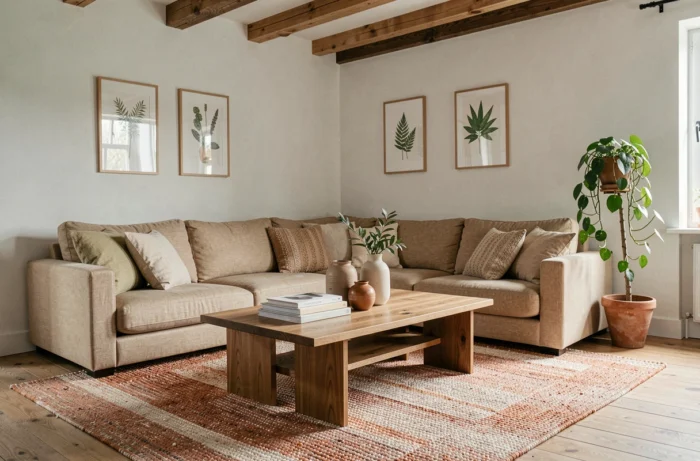
A rented apartment, white walls that cannot be repainted, drill holes prohibited by the lease: the majority of tenants in France navigate these constraints to furnish their interiors. Interior decoration is not just about choosing a sofa or hanging a frame. It relies on concrete trade-offs between comfort, budget, and reversibility, especially when you do not own the walls.
Reversible decoration in rentals: the levers that truly change a room
The rental constraint encourages a rethinking of the decorative approach through removable layers. Instead of thinking in terms of renovation, it is about layering elements that can be removed without leaving traces. Three families of solutions stand out for their visual impact/reversibility ratio.
- Heavy textiles (velvet curtains, thick throws, cushions with varied textures) absorb sound, warm up a cold room, and can be changed in minutes. A blackout curtain in linen or velvet radically alters the lighting ambiance of a bedroom without touching the structure.
- Accent lighting (table lamps, warm white LED string lights, candles) replaces the standard ceiling light and creates zones of soft light. It is the most underestimated lever for transforming a bland space into a cozy nook.
- Rugs and mobile dividers (screens, open shelves on wheels) redefine a studio or living room without drilling a single wall. A thick rug placed under a sofa corner is enough to visually delineate a cozy space in an open room.
Resources like leterrierdelily.com regularly explore these lifestyle approaches, intersecting decoration and everyday constraints.
A warm interior does not depend on the right to drill the walls. Adhesive solutions (Command hooks, washi tape, repositionable wallpaper) have improved in quality in recent years. They allow you to hang frames, create a graphic headboard, or place lightweight shelves without risking your deposit.
Creating a cozy atmosphere room by room: bedroom, living room, small space
A common mistake is to apply the same decor recipe to all rooms. A cozy bedroom is not designed like a living room, and a studio imposes different compromises than a partitioned apartment.
The bedroom: prioritizing sleep and materials
The bedroom is the room where the cocoon effect is most directly measured by sleep quality. Favoring muted colors and natural materials around the bed (washed linen, brushed cotton, wool) reduces visual stimulation. Deep shades (terracotta, sage green, midnight blue) work even on simple bed linens, without repainting.
Layered bedding (sheet, light blanket, throw, cushions of various sizes) gives an enveloping look. Velvet blackout curtains complement this setup by blocking outside light.
The living room: refuge zones in a shared space
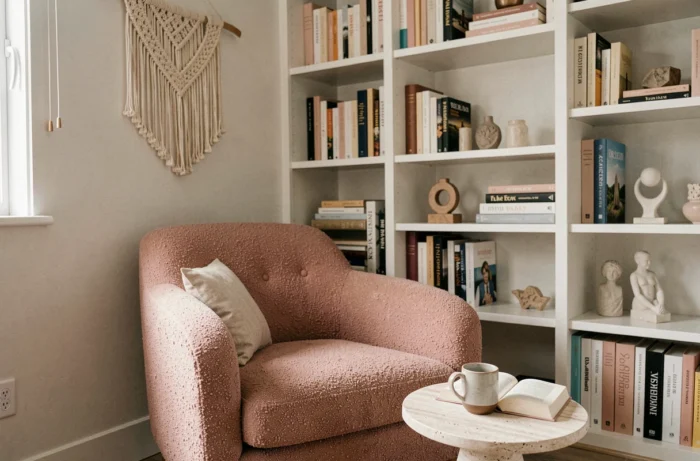
A cozy living room relies less on furniture than on creating micro-zones. An armchair oriented towards a source of natural light, a plush rug, a reading lamp: these three elements are enough to create a refuge corner in a family living room.
Green plants often play a role reduced to decoration, while they actually change the perception of a space. Two or three plants of different sizes, placed at varying heights (floor, furniture, hanging), break the monotony of a rectangular room.
The studio or small space: every square meter counts
In a compact apartment, decoration must integrate circulation. A poorly placed piece of furniture blocks a passage and cancels any cocoon feeling. Multifunctionality takes precedence over pure aesthetics: a pouf with storage, a folding table fixed to the wall, a lofted bed with a desk underneath.
Light colors on large surfaces (walls, floor, bed) and touches of color on small objects (cushions, candles, vases) avoid a suffocating effect without sacrificing personality.
Personal items and memory: building a unique interior without buying new
Interior decoration catalogs showcase perfectly coordinated interiors but lack uniqueness. A truly personal cocoon is also built, sometimes especially, with what already exists.
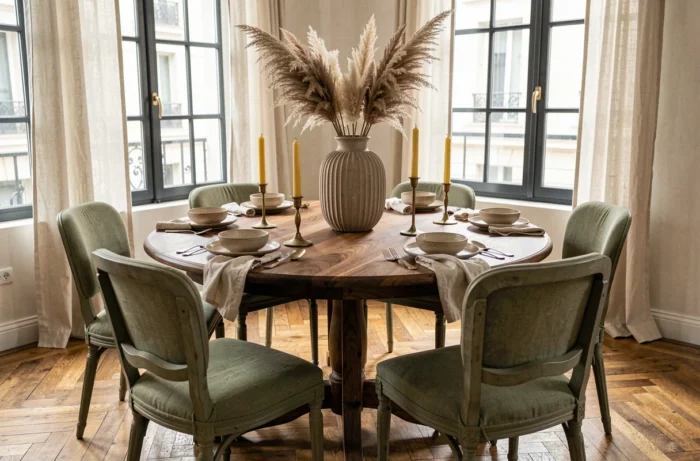
Inherited objects (antique tableware, family frames, fabrics brought back from travels) bring a narrative dimension that no store purchase can replicate. A unique interior is distinguished by what cannot be bought elsewhere. A collection of framed postcards, an African fabric transformed into a cushion, an old flea market mirror: these elements tell a story.
Local handmade creations (ceramics, candles, artist prints) serve the same purpose. They sometimes cost less than an industrial decorative object and bring a texture, a deliberate imperfection that breaks uniformity.
DIY (macramé, natural dyeing on fabric, furniture customization with adhesive paper) offers another lever. Field feedback varies on this point: some find the exercise rewarding, while others give up due to lack of time or satisfactory results. A reasonable approach is to start with a simple project (a cushion, a plant hanger) before tackling a pallet headboard.
Seasonal cozy decor: adapting your interior without changing everything
A cocoon does not have the same texture in January as in July. Seasonal adaptation is a rarely addressed angle, yet it extends decorative pleasure without multiplying purchases.
In autumn and winter, thick materials take over: velvet, faux fur, boucle wool. Colors warm up (ochre, burgundy, forest green). Scented candles and soft lighting complete the effect.
In spring and summer, lightening textiles and brightening hues renew the ambiance without moving the living room. Replacing a wool throw with a crinkled cotton throw, swapping dark cushions for pastel or natural tones, adding fresh flowers: these gestures take just a few minutes.
The principle remains the same: working with layered elements allows you to modulate the atmosphere of a room over the months, without heavy investment or renovations. A limited stock of cushion covers, two sets of curtains, and a few seasonal decorative items are enough to keep an interior lively all year round.