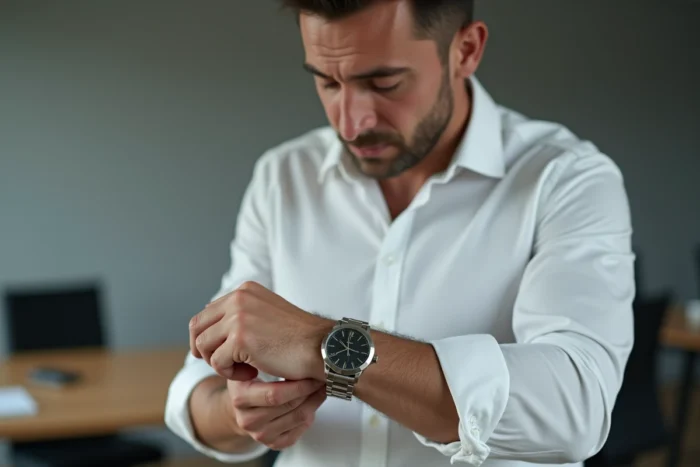
On a construction site, a nurse mechanically turns their watch face inward on their wrist before putting on gloves. A soldier on patrol makes the same gesture before donning their arm protection. The common point between these two situations is not mystical: wearing a watch upside down primarily responds to a practical constraint. Seeking a unique meaning for this gesture ignores the diversity of contexts in which it arises.
Protection of the watch face and resale value of an upside-down watch
We start with the most concrete case. Turning the watch face inward reduces the exposure of the glass to hard surfaces. Tables, walls, equipment: micro-scratches accumulate quickly when working with hands.
This logic takes on a financial dimension when the watch has value. In the second-hand market, the condition of the glass and case directly influences the resale price. Limiting impacts protects an investment, not just an object. Collectors who wear pieces worth several thousand euros daily often adopt this reflex without seeing any symbolism in it.
This habit is also found among people working in physical environments, well beyond the watchmaking circle. Mechanics, craftsmen, maintenance technicians: the gesture is purely utilitarian. Some wearers also find an advantage in terms of readability, as a discreet glance at the inner wrist is enough to tell the time, which leads us to explore the spiritual meaning of wearing a watch upside down from a broader perspective.

Upside-down watch in military and tactical environments
Wearing a watch upside down in the armed forces is not an action movie cliché. It addresses two specific operational issues.
- The reflection of the sun on an exposed watch face can betray a position. With the face turned inward on the wrist, this reflection risk disappears, which is crucial in patrol or observation situations.
- Reading the time while keeping hands on a weapon or steering wheel is easier when the face is facing oneself, on the inner side. One can slightly turn the wrist without losing grip.
- The protected face is less likely to break against a bulletproof vest, a backpack, or technical equipment worn on the forearms.
This gesture has been passed down from field units to outdoor sports enthusiasts and tactical watch aficionados. The military context normalized the upside-down wear long before a symbolic meaning was sought.
Upside-down wear among caregivers and in medical settings
Nurses often turn their watches for a direct ergonomic reason. During a pulse check, they hold the patient’s wrist with their fingers, inner face toward themselves. If the watch face is already oriented that way, they can count the beats and read the seconds in the same visual field, without twisting their arm.
This detail may seem trivial, but in a service where this gesture is repeated dozens of times a day, the upside-down wear becomes a work tool rather than an aesthetic choice. Feedback varies on this point depending on each caregiver’s habits, but the practice is documented in nursing schools as a professional reflex.
Medical staff sometimes add a hygiene reason: the face turned toward the wrist is less in contact with surfaces and patients. This does not replace handwashing but reduces direct friction.
Upside-down watch as a code of discretion and personal style
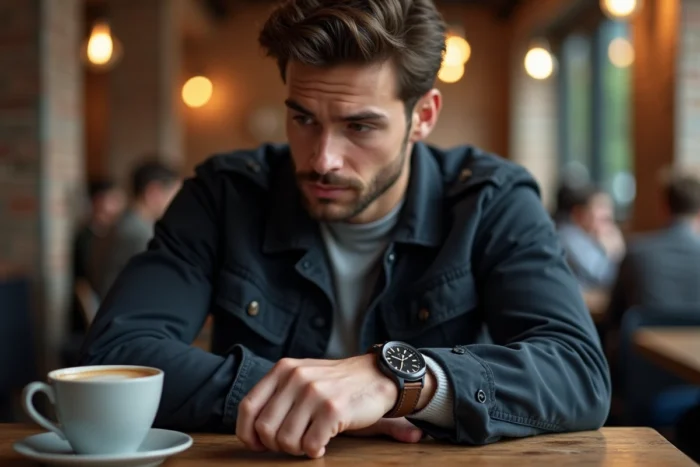
Outside of physically demanding jobs, the upside-down wear also exists in a social context. Wearing a luxury watch with the face visible can be perceived as ostentatious. Turning the face inward means wearing a beautiful piece without displaying it.
This code of discretion is not based on a formal etiquette rule. It can be found in certain professional environments where showing an expensive watch would be frowned upon, such as public service or the non-profit sector. The gesture then signals a relationship to status and material wealth: one owns the object but chooses not to show it.
A choice that depends on context, not a fixed symbol
Attributing a universal meaning to upside-down wear would be reductive. The same gesture changes meaning depending on whether one is a surgeon, a competitive shooter, or a discreet collector. Upside-down wear is a contextual usage, not a stable social code.
Some situations where the gesture takes on a different meaning:
- In shooting competitions or motorsports, the inward face facilitates chrono reading without altering hand positions.
- In diving, some wearers turn the watch to read the face through the mask’s lens without raising their arm.
- In daily life, some people adopt this position for simple comfort, as the crown no longer digs into the back of the hand during wrist flexion movements.
The choice of wearing it on the right or left wrist adds another variable. Convention places the watch on the non-dominant wrist to protect the mechanism and facilitate crown manipulations. The orientation of the face, however, remains strictly personal.
Wearing a watch upside down conveys different meanings depending on whether one is putting on nitrile gloves or entering a meeting room. The gesture does not need a single explanation to make sense: its meaning arises from the specific situation in which it is practiced.