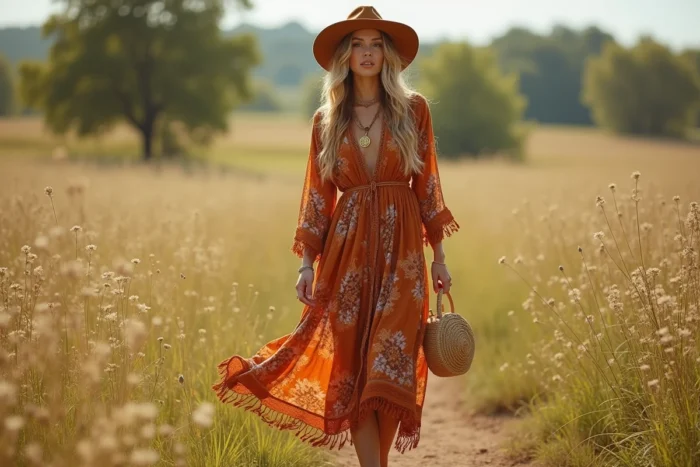
The hippie chic style is making a comeback in women’s wardrobes in a form that the 70s might not fully recognize. Recent collections, documented by Harper’s Bazaar and C&A, showcase a toned-down seventies silhouette: flare cuts in shades of beige and mocha, natural materials like washed linen or organic cotton, and minimal prints. This contrast between the original saturated flower power and its contemporary version deserves attention.
Hippie chic and quiet luxury: what current collections have changed
Most fashion guides present the hippie chic style as an assembly of fringes, floral patterns, and bright colors. The 2025-2026 runway shows and selections tell a different story. The dominant trend is one of color neutralization and simplification of prints, featuring fluid pieces in natural tones rather than tie-dye tunics.
This evolution blurs the line between bohemian and minimalism. A cream linen flare pant worn with a structured top doesn’t scream “70s,” but it captures the cut and spirit of movement. Browsing hippie women’s clothing on Zaza Mode allows one to measure this range, from bold flower power to more refined pieces.
The choice of materials illustrates this shift well. While the “authentic” hippie of the seventies widely used cheap synthetic fabrics, the current hippie chic favors linen, organic cotton, and vegan suede. Comfort remains central, but textile quality has taken precedence over decorative accumulation.
Flare pants and wrap dress: two silhouettes not to be confused
Two pieces consistently return in seventies-inspired wardrobes, but they create very different looks.
The flare pant
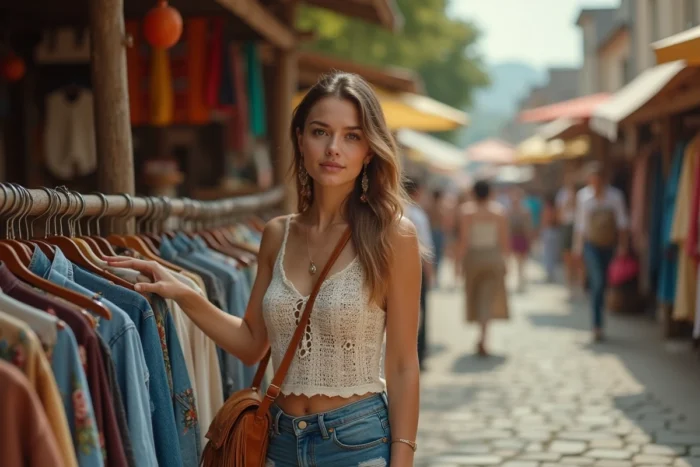
The flare pant, or bell-bottom, remains the most identifiable piece of the 70s wardrobe. Its fitted cut at the hips then flared from the knee elongates the silhouette. In contemporary hippie chic, it is worn in corduroy for fall or in raw denim for a more urban vibe.
A common mistake is to pair it with an equally loose top. A flare pant gains clarity with a fitted or semi-fitted top, whether it’s a bodysuit, a tucked-in blouse, or a thin sweater. The volume is concentrated in one area of the silhouette.
The wrap dress, an overlooked piece of hippie chic
Fashion content rarely associates the wrap dress with the hippie chic style. Historical guides, however, remind us that this cut was widely worn by women in the 70s, including those adopting a bohemian silhouette. Its crossover construction, adjustable without a zipper, aligns with the same logic of comfort and fluidity as the rest of the seventies wardrobe.
The wrap dress is probably the most versatile piece of the hippie chic style. In a discreet floral print, it leans towards bohemian. In solid linen, it effortlessly joins the quiet luxury trend.
Materials and prints: how to distinguish a hippie chic look from a costume
The line between inspired outfit and themed costume hinges on a few technical details that most guides overlook.
- Corduroy, in a midi skirt or short jacket, anchors a look in the seventies without overwhelming it. Its texture alone is enough to evoke the era.
- Vegan suede works well on short pieces: sleeveless vests, A-line skirts, wide belts. On a long piece, the risk of veering into costume increases.
- Floral prints remain relevant as long as their surface area is limited. A single patterned garment per outfit is a reliable marker. Two create an almost systematic “costume” effect.
- Denim, in all its variations (raw, washed, patchwork), plays a binding role between more pronounced 70s pieces. A raw denim flare jean paired with an embroidered blouse is enough to create a complete hippie chic look.
Accessories and hairstyle: details that date (or modernize) a 70s look
Accessories pose a specific challenge for the hippie chic style. Too subtle, they erase the seventies reference. Too pronounced, they turn the outfit into a costume.
Pieces that work in a contemporary register include wide belts worn on the hips, oversized sunglasses with tinted lenses, and short-fringe suede or vegan suede bags. Headbands, peace and love necklaces, and floral headbands lean more towards costume than everyday fashion.
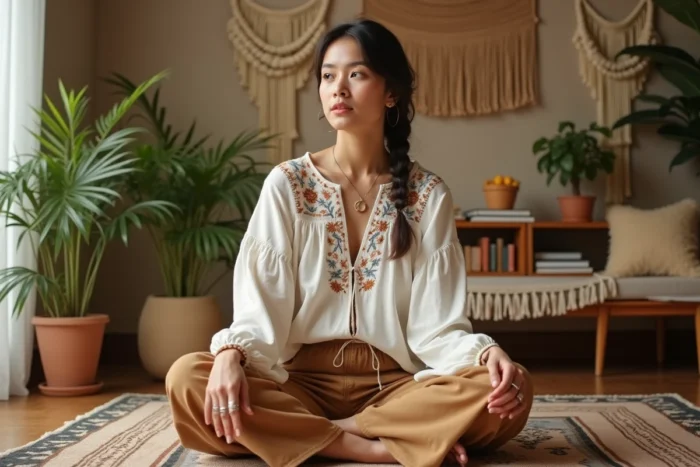
Hairstyle plays an often underestimated role in grounding a hippie chic look. Recent analyses describe hairstyles as a determining element for visually “dating” an outfit. A middle part with loose waves, smooth shoulder-length hair, or a loose low bun immediately situates a look in the seventies universe, without any additional accessories.
In contrast, highly styled hairstyles (tight curls, high buns, strict straightening) create a visual dissonance with the fluidity of hippie chic clothing. The coherence between the relaxation of the hairstyle and that of the clothing conditions the credibility of the look.
The fluid pant suit, another historical piece from the 70s, offers an alternative for more formal contexts. Worn in lightweight fabric with flat sandals, it retains the bohemian spirit while stepping away from the casual register. Field reports vary on its ease of daily wear, but its presence in current selections confirms that it remains a viable option for those seeking a hippie chic style suitable for a professional setting.