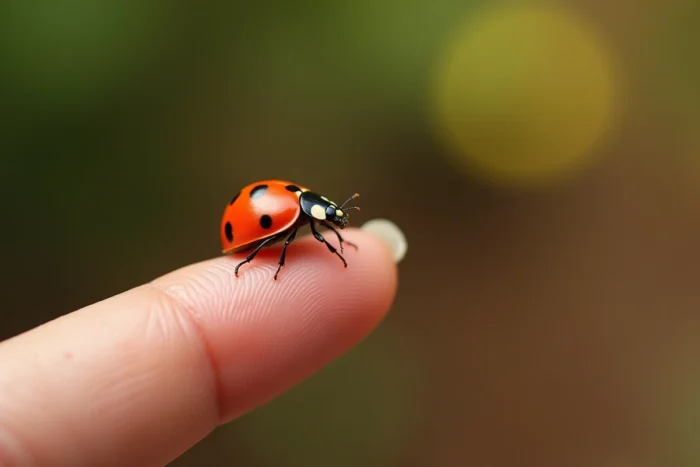
A ladybug resting on an interior wall or a curtain raises two very different interpretations depending on whether one looks at it with a spiritual guide or an entomology manual. The gap between these two perspectives deserves to be measured, as the observed species, the season, and the number of individuals radically change the interpretation. This article compares the meanings attributed to the ladybug in the home according to various traditions, and then confronts each belief with the available biological data.
Seven-spotted ladybug or Asian ladybug: two insects, two interpretations
The first variable to identify is the species. The seven-spotted ladybug (Coccinella septempunctata), bright red with well-defined black spots, is the one that European traditions associate with luck and divine protection. It has been nicknamed God’s little creature since the Middle Ages.
The Asian ladybug (Harmonia axyridis), on the other hand, has very variable coloration (orange, yellow, sometimes black) and an irregular number of spots. Its behavior is also different: it seeks refuge in large numbers in homes starting in the fall to survive the cold. Entomologists specify that it can enter by the dozens, which is a seasonal aggregation behavior, not a mystical sign.
When considering the spiritual meaning of the ladybug in the home, this distinction between species is rarely made. The table below summarizes the differences.
| Criterion | Seven-spotted ladybug | Asian ladybug |
|---|---|---|
| Dominant color | Bright red | Orange, yellow, variable |
| Number of spots | Always 7 | Variable (0 to more than 19) |
| Entry into the house | Isolated individual, often accidental | In groups, seasonal behavior |
| Traditional symbolism | Luck, protection, divine messenger | No ancient tradition associated |
| Ecological status | Native species in Europe | Invasive introduced species |
Confusing the two amounts to imposing medieval symbolism on a recent biological phenomenon. Therefore, identifying the species is the prerequisite for any interpretation.
Popular beliefs about the ladybug: what each tradition attributes to its presence
Several cultures have woven stories around this insect. Interpretations vary, but three themes consistently emerge: luck, love, and protection.
Ladybug and luck in European tradition
In France, the most widespread legend links the ladybug to divine intervention. A death row inmate was spared because a ladybug landed on his neck, interpreted as a sign of grace. The insect has since been associated with good fortune and home protection.
In Anglo-Saxon tradition, there is a nursery rhyme (Ladybird, Ladybird) that connects the ladybug to returning home and the safety of children. The common thread remains the same: the ladybug as a positive messenger.
Ladybug, love, and number of spots
A modern belief assigns a coded meaning to the number of spots: two spots for love, seven for great luck, etc. Scientific popularizers have clearly debunked this interpretation. The number of spots depends on the species and genetics, not a system of omens. These interpretations are described as modern constructions without basis in an ancient written tradition.
The ladybug as a spiritual sign of transformation
In some personal development approaches, the ladybug in the home is read as a sign of positive energy, renewal, or spiritual protection. The symbol is based on the insect’s metamorphosis cycle (larva, pupa, adult), associated with inner transformation.
- Presence of an isolated red ladybug: interpreted as encouragement or a sign of luck in most traditions
- Ladybug on the hand or body: often associated with the fulfillment of a wish in French folklore
- Ladybugs in groups indoors: more of an ecological indicator (autumn aggregation) than an amplified spiritual message
Ecological indicator of the garden: the ladybug as a concrete signal
Beyond the symbolic dimension, the presence of ladybugs near the house provides information about the state of the garden. Ladybugs primarily feed on aphids. An active population of ladybugs means that the garden hosts enough prey, indicating that the local ecosystem is functional and minimally chemically treated.
This reading is increasingly used as an informal indicator of biodiversity. Agricultural popularization content reminds us that the ladybug is part of the natural auxiliaries of the garden, alongside lacewings and hoverflies.
In contrast, a massive invasion of Asian ladybugs in the house does not signal a healthy garden. It indicates an imbalance: this invasive species competes with native ladybugs and can cause domestic inconveniences (secretions, stains on walls).
- One to three seven-spotted ladybugs on roses or vegetables: a sign of a balanced garden with a natural presence of aphids
- Dozens of Asian ladybugs on facades in autumn: seasonal survival behavior, not a sign of favorable biodiversity
- Total absence of ladybugs despite the presence of aphids: a possible indicator of excessive use of pesticides

Spiritual or biological: interpretative framework depending on the observed context
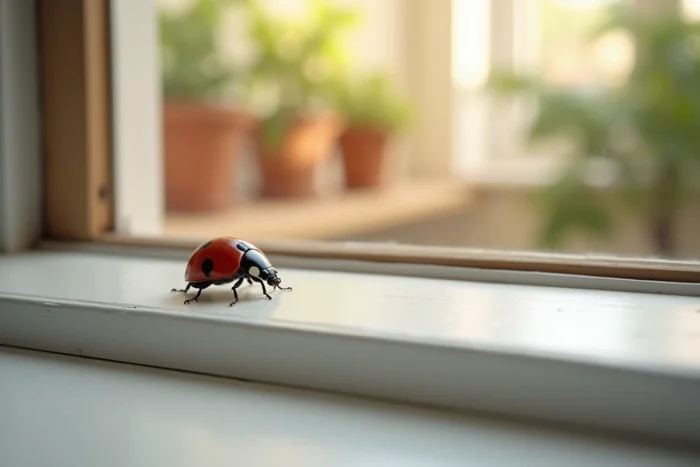
The question is not to choose a side, but to understand what one is observing. An isolated red individual resting on a window in spring does not have the same practical significance as thirty orange ladybugs clustered on a door frame in October.
For the first situation, the symbolic reading (luck, protection, positive message) is based on centuries of documented folklore. For the second, the relevant response is entomological: check for entry points, ventilate, and possibly relocate the insects without crushing them.
The number of spots, the color, and the behavior of the insect do not belong to the same interpretive register. Confusing them produces content where the Asian ladybug inherits a symbolism that does not pertain to it, and where the seven-spotted ladybug is reduced to a pest problem. Identifying the species, observing the season, and counting individuals remains the most reliable starting point, whether one is seeking a sign or an explanation.