
An e-commerce site that generates traffic but doesn’t convert, an active Instagram page with no impact on revenue, advertising campaigns that cost more than they bring in: these situations are the daily reality for many online businesses. The marketing strategies that work today are no longer the same as those from two years ago. Customer journeys are fragmented across search engines, social networks, marketplaces, and AI-powered chatbots.
Making Your Offer Readable by AI Response Engines
For a long time, product listings were optimized solely for Google. That is changing. Customers are asking questions directly to chatbots, which pull their answers from structured web content. If your catalog is not readable by these systems, you are losing an increasing share of visibility.
Specifically, we work on three levers. First, product listings with clear and complete attributes: material, dimensions, compatibility, usage. Next, integrated and tagged customer reviews, because LLMs (language models) rely on this feedback to formulate their recommendations. Finally, consistency in pricing and availability between your site and third-party platforms.
This optimization work resembles classic SEO, but with an additional requirement: factual accuracy. An AI response engine does not forgive vague descriptions or contradictory information between two pages. To delve deeper into these mechanisms, there is marketing information on Cyber Business that details how to adapt your presence to these new channels.
Multichannel Marketing Strategy: Coordinate Rather Than Stack
Many online businesses multiply channels without connecting them. A TikTok account here, a newsletter there, Google Ads next to it. The result: incoherent messages and a dispersed budget.

An effective multichannel strategy relies on a unified customer journey. It starts from the actual behavior of the buyer. They discover a product on social media, compare on Google, read reviews on a marketplace, and then return to purchase via a link in a newsletter. Each touchpoint must tell the same story, with the right level of detail.
To achieve this, we start by mapping the steps of the purchasing journey specific to our activity. For a product under 30 euros, the cycle is short: social media and retargeting are often sufficient. For a service offer or a technical product, web content (articles, guides, comparisons) plays a reassuring role over several weeks.
- Identify the two or three channels where your customers actually spend time, instead of trying to be everywhere
- Synchronize messages between email, social media, and your website so that each interaction extends the previous one
- Measure the complete journey (multichannel attribution) rather than the performance of each channel in silos
- Continuously reallocate the budget to channels that generate conversions, not just impressions
Feedback varies on this point depending on the sectors, but in most cases, focusing efforts on two well-articulated channels yields better results than managing five poorly coordinated ones.
Content and SEO: Produce Less but More Targeted
Publishing three blog articles a week without a clear editorial line is no longer very effective. Google’s algorithms value depth and relevance. A well-structured article that answers a specific question from your target audience generates more qualified traffic than a dozen superficial texts.
We apply a simple method: start from the queries that potential customers actually type. Keyword research tools provide a starting point, but the real goldmine is found in questions asked to customer service, product reviews, and specialized forums.
Good marketing content solves a concrete problem for the reader. For example, a site selling office equipment has more to gain from publishing a detailed comparison “ergonomic chair for remote work” than a generic article on “the importance of well-being at work.”
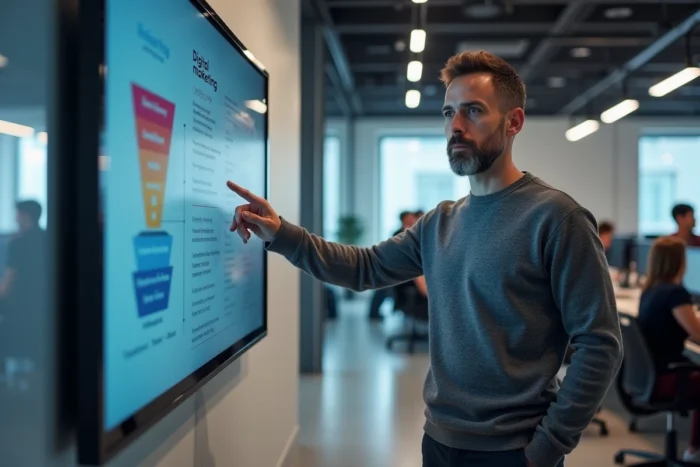
The video format deserves special attention. Social networks prioritize this format in their algorithms, and consumers increasingly use it to evaluate a product before purchase. A short video showing a product in real-life situations effectively complements a written product listing.
AI-Driven Marketing Automation: Beyond Scheduled Emailing
Automation is no longer limited to sending a follow-up email after a cart abandonment. Current tools integrate real-time analysis and adjustment capabilities. We are talking about agentic AI: systems capable of segmenting, testing, and adapting campaigns almost autonomously.
In practice, this means a tool can modify the subject line of an email, adjust the sending time, or change the visual of an ad based on performance observed in the first hours. The gain is not just in time: it’s the ability to react faster than a human could do manually across dozens of customer segments.
- Set up follow-up scenarios tailored to actual behavior (pages viewed, time spent, products consulted)
- Use dynamic segmentation to send relevant offers rather than generic promotions
- Systematically test variations (A/B testing) on email subjects, visuals, and calls to action
Automation works when it relies on clean customer data. Without a well-structured database, even the best tool will produce mediocre results. We start by cleaning our lists, unifying customer profiles across different platforms, and ensuring that GDPR consent is in order.
Online marketing in 2025 rewards consistency and accuracy. Multiplying tactics without an overarching vision remains the most common trap. The companies that progress are those that choose a few channels, master them, and measure each action against a clear conversion objective, not against the number of likes or impressions.