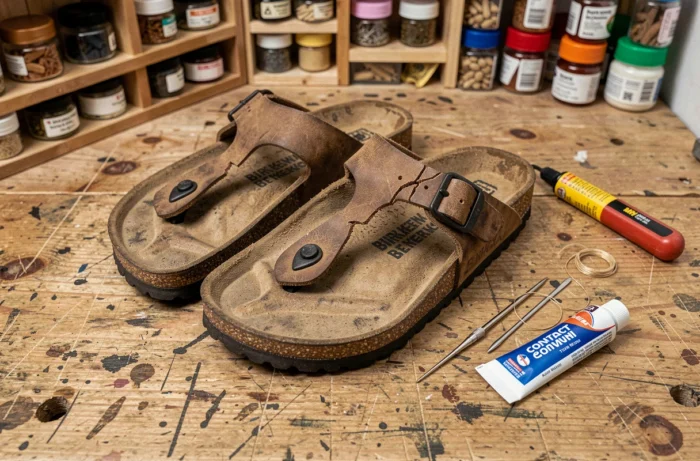
A loose strap on a pair of Birkenstocks does not necessarily mean the end of the sandal. The type of break, the material of the strap, and the condition of the cork footbed determine the appropriate repair method, and especially its durability. This article compares the available options, from DIY gluing to taking it to a cobbler, measuring what each solution actually offers.
Broken Birkenstock Strap: Comparison of Repair Solutions
Not all repairs are equal. The choice depends on the type of damage (strap detached from the cork, broken stitching, torn buckle) and the acceptable budget. The table below summarizes common options.
| Method | Type of Break Targeted | Estimated Durability | Indicative Cost |
|---|---|---|---|
| Specialized contact adhesive (Barge Cement, Shoe Goo) | Strap detached from cork | Several months to over a year if done well | Low (price of a tube) |
| Cobbler stitching | Broken stitching or torn strap | Comparable to new condition | Variable depending on the shop |
| Complete strap replacement (cobbler) | Irreparable strap or torn buckle | Equivalent to new | Higher, depends on the material |
| Birkenstock warranty | Manufacturing defect | Pair replacement | Free if eligible |
Specialized contact adhesive dominates online feedback for cases of simply detached straps. However, a torn leather strap or a pulled metal buckle requires cobbler work.
To better understand each scenario, a detailed guide allows you to assess whether you can repair a broken strap on Birkenstocks yourself or if a professional is necessary.
Contact Adhesive on Birkenstock Cork: Technique and Limits
Contact adhesives like Barge All-Purpose Cement or Shoe Goo have become the reference among amateur repairers and some North American cobblers. Their adhesion to the cork-latex mixture of the Birkenstock footbed is significantly superior to that of mainstream adhesives.
Effective Re-gluing Protocol
The success of re-gluing relies less on the product and more on the preparation. Here are the steps that consistently appear in documented feedback:
- Clean both surfaces (strap and cork) with a slightly damp cloth, then let dry completely before any application.
- Apply a thin layer of glue on each surface, wait until it becomes tacky to the touch (about fifteen to twenty minutes depending on the product), then press firmly.
- Keep the strap under pressure (clamp, wide elastic, heavy object) and let it dry for a full night before wearing the sandal.
This last step is the most often neglected. Incomplete drying results in weak adhesion that gives way after a few days of walking.
What Glue Does Not Resolve
If the strap is made of Birko-Flor (a synthetic material used on many models) and has split through its thickness, re-gluing does not restore the mechanical strength of the strap. The repaired area remains a weak point that will give way again under tension. In this case, taking it to a cobbler for reinforcement stitching or partial replacement is the only sustainable option.
Cobbler Repair: Stitching and Strap Replacement
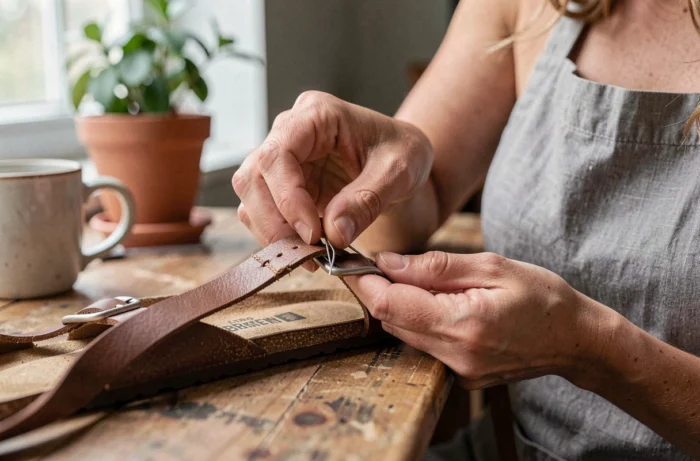
A cobbler has tools that DIY re-gluing cannot replace: sewing machine for leather, durable waxed thread, and most importantly, the ability to work with new leather to create a custom strap.
Stitching applies when the strap itself is still intact but the junction with the sole has come loose. The cobbler then stitches directly through the cork and the strap, creating a mechanical fixation that is much stronger than simple gluing.
Complete strap replacement occurs when the leather or Birko-Flor is too damaged. The cobbler removes the old strap, prepares the cork surface, and attaches a new strap. The result depends on the quality of the chosen material: full-grain leather close to the original gives a result nearly identical to new.
Finding a Suitable Workshop
Not all cobblers work on Birkenstocks. The specificity lies in the cork-latex footbed, which is more fragile than a standard sole. Some specialized workshops offer a service by postal mail, which expands options for those far from a good craftsman.
Birkenstock Spare Parts: An Almost Non-Existent Channel
One of the major obstacles to self-repair is the absence of spare parts sales by Birkenstock. For several years, the brand has not supplied buckles, straps, or upper components for retail. Requests made to customer service are redirected to retailers or partner cobblers, with no direct channel to purchase a specific component.
This policy pushes in two opposite directions. On one side, the complete replacement of the pair via warranty (if the defect is manufacturing-related). On the other, the need to go to a cobbler who will use their own materials, which explains the variability of results from one workshop to another.
In contrast, some shoe manufacturers are beginning to offer spare parts online. For Birkenstock owners, this option is not yet officially available.
Birkenstock Warranty and Broken Strap: What It Actually Covers
The legal warranty of conformity covers manufacturing defects found within the time limits set by law. A strap that breaks after a few weeks of normal use may fall under this warranty, provided that the proof of purchase has been retained.
In practice, Birkenstock offers replacement of the pair rather than targeted repair. The process goes through the original retailer or customer service. Recent consumer feedback indicates that the brand does not perform partial repairs under warranty.
This point deserves attention: a strap that breaks after several seasons of heavy use will not be covered. In this case, cobbler work or re-gluing remain the only viable options.
The choice between DIY repair and cobbler work comes down to the nature of the break. A strap detached from the cork can be well-supported by careful re-gluing with specialized contact adhesive. A split strap, a torn buckle, or a ripped leather requires professional work. The absence of spare parts sold by Birkenstock makes the cobbler all the more central to the lifespan of these sandals.