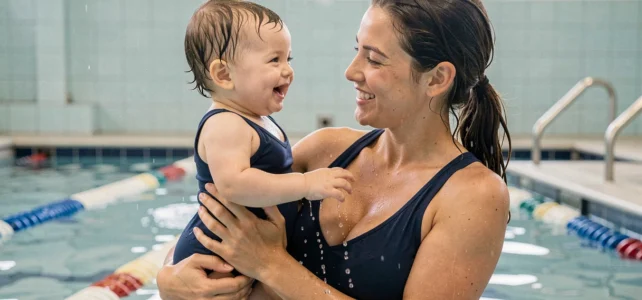
When looking for a water activity for a baby a few months old in Poitiers, the first challenge is not finding a pool, but knowing if the proposed time slot truly meets the needs of the child. Pool temperature, session duration, supervision: these parameters vary from one facility to another, and the feedback from parents who have been there remains the most reliable filter before committing to a season.
Thermal comfort of the pool: the criterion parents mention first
On forums and in locally gathered testimonials, one point consistently arises: the water temperature. At the Blaiserie pool, where Stade Poitevin Natation organizes its baby swimming sessions every Saturday, the water is specially heated for little ones. Feedback indicates that the water is maintained at around 31 to 32 °C, which limits shivering and allows babies to stay relaxed longer in the pool.
This detail may seem trivial, but it conditions the success of the session. A baby who is cold cries, tenses up, and ultimately associates water with a negative experience. Parents who have tried other pools with cooler water confirm this: the difference in behavior is clear from the first contact.
By consulting the feedback on baby swimmers in Poitiers, this constant is found: thermal comfort is the number one factor for parental satisfaction, well ahead of price or location.
Entry age and duration of baby swimming sessions in Poitiers
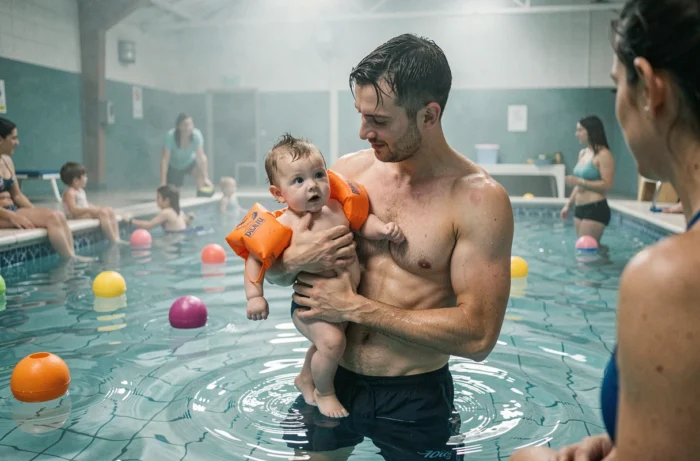
Stade Poitevin Natation welcomes children from 5 months to 3 years old. This is a fairly standard range, but it deserves clarification: the first months of a baby in the water are nothing like the sessions of a 2-year-old. At 5 or 6 months, we mainly talk about contact with water, parental carrying, and small guided immersions. The goal is not to learn to swim but to develop confidence in the aquatic environment.
Sessions last about thirty minutes, a format suited to the attention span and physical endurance of little ones. Several parents note that exceeding this duration would be counterproductive: fatigue sets in quickly, especially for those under one year old.
What parents observe according to age
- Before 8 months, babies primarily react to the contact with water and the parent’s voice. The sessions are calm, focused on rocking and familiarizing with the environment.
- Between 8 and 18 months, children start splashing, grabbing floating toys, and accepting small immersions of the face. This is the period when progress is most visible from one session to the next.
- After 18 months, some children develop real comfort in the water: moving with support, jumping from the edge with parental reception, and first notions of floating on their back.
Feedback varies on this point: some babies are comfortable from the first session, while others need several weeks to relax. Parents who persist beyond the first three or four sessions almost always notice positive development.
Fear of water in toddlers: what parents say on the ground
A common topic in reviews is managing fear. Some babies cry as soon as they enter the pool. Others freeze upon contact with water. The initial reaction does not predict the child’s future relationship with swimming at all.
In Naintré, the lifeguards of Grand Châtellerault have undergone specific training to supervise little ones in the pool. Trainer Cédric Palisser, who came from Montbéliard, emphasizes one principle: the earlier a child is put in the water, the more they understand buoyancy. This notion of buoyancy is the body’s ability to float naturally. A child who feels it early develops reflexes that reduce the risk of panic in real situations.
Several parents also report that baby swimming sessions have had an unexpected effect at home: the evening bath becomes easier, the child accepts water on their face better, and shampooing goes without screams. This is not the main argument put forward by facilities, but it is a concrete benefit that families often mention.
Price and commitment: what a season of baby swimming represents
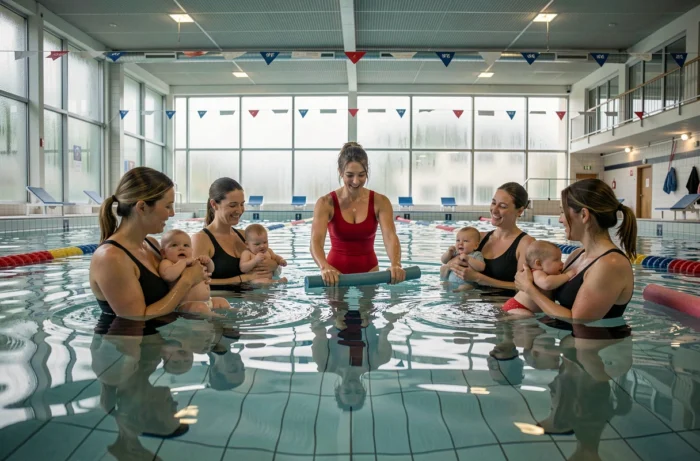
At Stade Poitevin Natation, the commitment is made for the season. The fee covers the baby swimming service as well as the club membership. Saturday morning slots are divided between 9 AM and 12 PM, in 30-minute intervals, from September to the end of June.
This seasonal operation has advantages and limitations. On the positive side: weekly consistency is the key factor for progress according to parental feedback. A baby who comes every week progresses significantly faster than a child enrolled sporadically.
On the constraint side: if Saturday hours do not suit, alternatives in Poitiers itself are limited. Facilities like Garden Blues or C’Tonique offer different packages, sometimes with more flexibility in time slots. In the outskirts, the Naintré pool remains an interesting option, especially for families in the northern part of the agglomeration.
Points to check before registering
- A medical certificate is generally required. Some pediatricians issue it without difficulty, while others request a complementary assessment for babies under 6 months.
- Appropriate swim diapers are mandatory in most pools. Bring several changes for the session.
- Popular time slots (9 AM and 10 AM on Saturday) fill up quickly. Anticipating registration as soon as September begins avoids being placed on a waiting list.
Baby swimmers in the outskirts of Poitiers: alternatives to watch
The Vienne only has a few slots dedicated to baby swimmers, creating a demand that exceeds supply. In Naintré, the pool does not exceed 1.20 meters in depth, allowing parents to always have their feet on the ground and manage their child safely. This type of configuration particularly reassures parents who are discovering the activity.
Some associations have sometimes suspended and then relaunched their baby swimming slots due to reorganizations or renovations. Checking the actual availability of sessions before committing avoids disappointments during the season.
The choice between central Poitiers and the outskirts mainly depends on the proximity to home and the time slot. Parents who have tried several facilities recommend prioritizing consistency over location: a pool ten minutes from home that you go to every week is better than a better-equipped pool thirty minutes away where you end up skipping sessions.