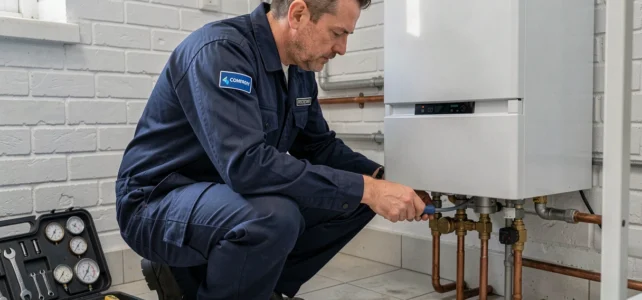
A Brussels landlord who needs to replace their gas boiler in a poorly insulated apartment is not looking for the same professional as a developer connecting a new building to a heat pump. The choice of a heating engineer in Brussels primarily depends on the type of project, the regulatory framework that applies, and the technician’s ability to manage the specific constraints of Brussels’ buildings.
Energy Performance Regulation and Gas Ban in New Builds: What the Heating Engineer Must Master
Since a Brussels decree on June 6, 2024, new (or equivalent) housing must, starting January 1, 2025, produce their heat solely through electricity, renewable energies, or an efficient heat network. From June 1, 2025, it is also prohibited to install oil boilers in these projects.
We are no longer simply talking about replacing one burner with another. The heating engineer becomes a player in energy renovation, capable of proposing solutions compatible with upcoming energy performance thresholds (class E by 2033, then C from 2045). If the professional you contact does not spontaneously mention your property’s energy performance label or the regulatory deadlines, that is a warning sign.
Specifically, during the first phone call, ask the question: “My property is rated F, what heating options allow me to reach E without completely redoing the insulation?” A heating engineer who dodges the question or only responds, “we’ll install a new gas condensing boiler,” has not integrated the current Brussels framework. You can also learn more on Facefull News to better understand the obligations before contacting an installer.

Heating Engineer Certifications in Brussels: Which to Check and Why
Belgium imposes specific certifications for working on thermal installations. In Brussels, a technician dealing with gas must hold the Cerga certification, issued after training and a practical exam. This certification confirms that they comply with safety standards for natural gas.
For air conditioning or heat pump installations, other certifications come into play, particularly for handling refrigerants. Feedback on this point varies depending on the type of device, but the basic rule remains simple: request a copy of the certification before signing any quotes.
Here are the documents to systematically request:
- The Cerga certification if the intervention concerns a natural gas installation, whether it is maintenance or boiler replacement
- The certificate of access to the profession of heating engineer, issued via the Crossroads Bank for Enterprises (verifiable online)
- A valid professional liability insurance covering any damages during the intervention
A serious professional will provide these documents without hesitation. If you are told, “we’ll send that after the job,” move on to the next.
Comparing Heating Quotes: Beyond the Total Price
Requesting three quotes is a common reflex. The problem is that we often only compare the bottom line. However, a detailed heating quote protects as much as a good price.
A serious quote in Brussels mentions the brand and exact model of the proposed device, the power in kW, the labor cost separate from the materials, and any additional work (flue adaptation, electrical compliance). If the quote fits into three lines, it lacks substance for comparison.
What Quotes Reveal About the Heating Engineer
An installer who proposes an air-water heat pump without having visited the property or checked the wall insulation is taking a risk. The sizing of a heat pump directly depends on the thermal losses of the building. A prior technical visit is a non-negotiable criterion of seriousness.
Also compare the announced timelines. In Brussels, qualified heating engineers for heat pumps are in high demand, especially between September and December. A response time of several weeks during peak season is not unusual, while immediate availability in the middle of autumn may raise questions about the professional’s workload.
Boiler Maintenance in Brussels: A Real-World Test
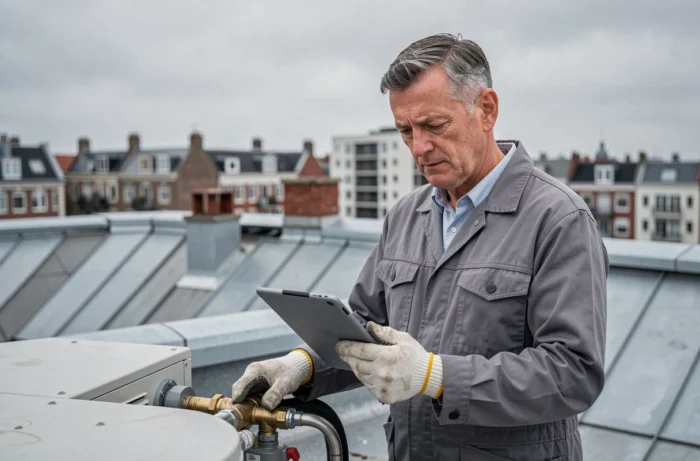
Before entrusting a complete installation to a heating engineer, you can test them with an annual maintenance. Boiler maintenance is mandatory in Belgium, and it is a relatively standardized service that allows for several evaluations in one visit.
Observe the working method: does the technician protect the floor, measure combustion emissions, and provide a compliant maintenance certificate? The legal maintenance certificate validates your home insurance; it is not an optional document. If the heating engineer leaves without giving it to you, follow up with them immediately.
Repairs and After-Sales Service
The real test of a heating engineer occurs when the boiler breaks down on a Sunday in January. Inquire, from the first contact, about the repair conditions: does the professional offer an emergency service? Do they charge a premium for weekend interventions? What is their average response time?
A local heating engineer, based in your municipality or a neighboring one, generally responds faster than a large company covering all of Belgium. Proximity remains a concrete advantage for repairs, even if it does not replace technical competence.
The choice of a heating professional in Brussels hinges on three concrete axes: their knowledge of Brussels’ energy performance obligations, their verifiable certifications, and the quality of their quote. Starting with an annual maintenance before entrusting them with a larger project remains the most reliable method to assess their seriousness on the ground.