
The size of a bra is based on two distinct measurements: the underbust measurement (under the breasts) and the bust measurement (at the fullest point of the breasts). The difference between these two values determines the cup letter, while the underbust measurement sets the number (80, 85, 90). Understanding this mechanism avoids approximations and failed purchases, especially at Etam, whose sizing chart follows the standard French norm.
Cup difference and underbust measurement: the logic behind letters and numbers
The number displayed on the label (75, 80, 85, 90) corresponds to a range of underbust measurements taken just under the breasts with a measuring tape held horizontally. This number does not represent the exact measurement in centimeters: it indicates a standardized range.
The cup letter (A, B, C, D, E) reflects the difference between the bust measurement and the underbust measurement. Each letter corresponds to an interval of about two centimeters. A more pronounced difference results in a larger cup, regardless of body size.
To successfully perform the Etam bra size calculation, you must take these two measurements separately and then cross-reference the results in the brand’s size chart. The Etam chart follows the same logic as those of La Redoute or other French retailers: the same calculation method works from one brand to another, simplifying comparison.
Measuring your underbust and bust without error
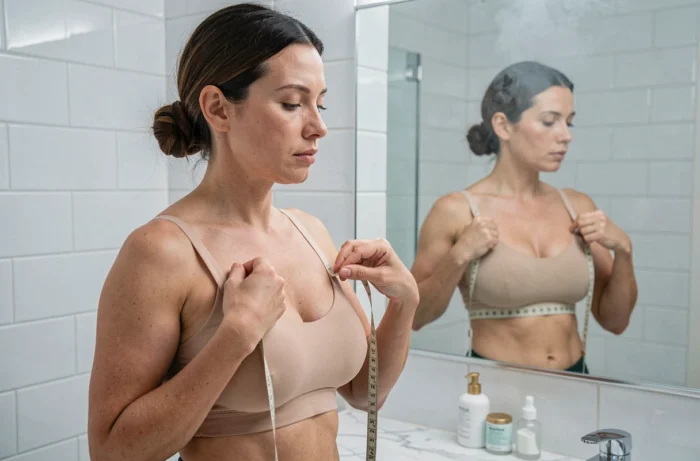
The necessary equipment consists of a flexible measuring tape. Take measurements on bare skin or with a thin, unpadded bra, standing with arms at your sides.

- The underbust measurement is taken directly under the breasts. The measuring tape should remain parallel to the ground, neither too tight nor too loose. Exhale normally before reading the value.
- The bust measurement is taken at the fullest point of the breasts, keeping the tape horizontal at the back. Do not compress the breasts or puff out your chest.
- If the breasts are soft or very projected, lean slightly forward while measuring the bust. This position redistributes the volume and provides a more reliable reading, as recommended by recent fitting calculators.
This so-called “morphological” method goes beyond simply reading a fixed chart. It takes into account the actual projection of the breast, not just the static measurement while standing.
Neighboring sizes at Etam: the sister size system
A sister size is a size that offers the same cup volume with a different underbust measurement. This concept is rarely explained clearly, yet it solves most fitting issues.
The principle: when you go up a band size, you go down a cup size, and vice versa. For example, an 85B shares the same cup volume as an 80C and a 90A. The amount of fabric in the cup remains the same; only the length of the band changes.
At Etam, this system is particularly useful for online shopping when trying on is not possible. If a model in 85B is tight at the back but the cup fits, switching to 90A may suffice without changing the bra shape.
Adjustment according to the type of Etam bra
The size calculated with the measuring tape does not guarantee a perfect fit on every model. A wireless triangle fits differently than a structured push-up, even if the size on the label is the same.
Models with wires should frame the breast without pressing on the breast tissue. If the wire rests on the breast rather than on the underbust, the cup is too small or the model is not suitable for the breast shape.
Soft bras and triangles are more forgiving of size discrepancies. Their stretchy cut accommodates a slight difference between the actual measurement and the chosen size. For these models, prioritize the size indicated by your underbust measurement rather than the cup size.
Molded cup bras, common in Etam collections, have a fixed shape. The breast should fill the cup without overflowing or leaving any gaps. A space at the top of the cup indicates a cup that is too large or insufficient projection for this model.
Concrete signs of a bad bra size
Rather than listing generalities, here are the three most reliable indicators to check the fit once the bra is on.
The back band should remain horizontal, parallel to the ground. If it rides up at the back, the underbust measurement is too large: the band is no longer doing its job of support, and the straps compensate, causing marks on the shoulders.
The center gore (the small piece between the two cups) should lie flat against the sternum. A gap between this piece and the skin indicates a cup that is too small or a model unsuitable for widely spaced breasts.
The straps should only serve as guides, not for support. If loosening the straps causes the bra to fall, the back band is too loose. Support comes from the back, not the shoulders.
These checks work regardless of the Etam model and prevent confusing a size issue with a shape issue. A bra that is the right size but in an unsuitable cut will also yield a poor result, which does not mean that the measurement is wrong.
The body changes over time, due to weight fluctuations and hormonal cycles. Taking your measurements every six months or so remains the most straightforward method to avoid wearing an unsuitable size.