
Yindofoyelaszoz. You may have come across this word on a social network, in a comment, or in a short video. No one really knows where it comes from, and it is precisely this ambiguity that has fueled its spread. This term, impossible to link to a known language, has spread across the French-speaking web in just a few weeks, driven by the curiosity of internet users and the very mechanisms of digital platforms.
Yindofoyelaszoz and the absence of verifiable trace
The first reflex when faced with an unknown word is to search for it. Typing “yindofoyelaszoz” into a search engine does not return any dictionary, patent database, or trademark registry. Cross-checking in university catalogs and publication databases revealed no verifiable record for this term or its variants like “yelaszozjindofo” or “jindofo,” according to an analysis published by Veriscope in August 2026.
This complete absence of official reference is remarkable in itself. On the web, most viral words end up being linked to a creator, a video game, a work, or an identifiable meme. Here, nothing of the sort. The word floats without an anchor, which has fueled all sorts of speculation.
As detailed in the article on yindofoyelaszoz by Cent pour Cent PME, this lack of clear origin has paradoxically enhanced the term’s appeal among content creators, each projecting their own theory onto it.
Search algorithms and the creation of mystery

Why can a word with no known meaning seem so fascinating after a few searches? The answer partly lies in the search engines themselves. Faced with an unknown term, algorithms link it by phonetic similarity to existing words. The fragment “yela” may be linked to a Senegalese ritual dance from the Boundou, while “zoz” triggers unfounded linguistic hypotheses.
This mechanism creates an illusion of cultural depth. An internet user searching for “yindofoyelaszoz” encounters snippets of results that seem to point to ancient traditions or secret codes. In reality, these connections are the product of automated processing, not a verified historical link.
This phenomenon has an informal name in the SEO community: the “algorithmic mystery”, where the absence of reliable data pushes engines to fill the gaps with approximate associations. The result is a vicious cycle: the more people search, the more engines create connections, and the more the word seems loaded with meaning.
Short video and virality on TikTok and YouTube Shorts
Short video platforms have played a crucial role in the spread of yindofoyelaszoz. The format of a few dozen seconds is perfectly suited for “unsolved mystery” type content. A creator films their screen, types the word, shows the strange results, and concludes with an open question. It’s that simple.
This type of content works because it simultaneously exploits three levers:
- Immediate curiosity: an unpronounceable word grabs attention in a stream of videos where every second counts to retain the viewer
- The feeling of shared discovery: commenting “I searched and it’s even weirder” creates a community effect that prompts the algorithm to redistribute the video
- The absence of a definitive answer: without a clear explanation, each new video can propose “its” theory, multiplying the content on the same subject
In 2026, analyses of these platforms show that terms without a clear definition generate more engagement than those that link to a Wikipedia page. Ambiguity is algorithmic fuel.
Online speculation and content creation without sources
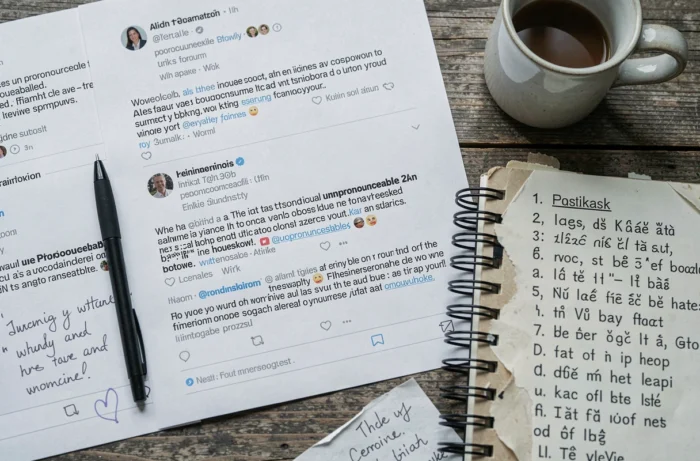
Yindofoyelaszoz illustrates a broader phenomenon: the web’s ability to transform an empty word into a cultural object. Blog posts, discussion threads, and videos have begun to attribute varied, sometimes contradictory origins to the term. Some see it as an acronym, others as a proper name from a rare language.
The problem is that none of these hypotheses withstand serious verification. Each “explanation” published online is based on assumptions, not on traceable documents or testimonies. This dynamic is not unique to yindofoyelaszoz. It recurs whenever an opaque term circulates quickly enough for content production to outpace verification.
Have you ever noticed that the most shared articles on these topics are rarely those that provide an answer, but those that pose the most questions? It’s a well-oiled mechanism. Uncertainty generates clicks, clicks generate visibility, and visibility attracts new creators who add an additional layer of speculation.
Yindofoyelaszoz as a case study of virality without content
What makes this case interesting from a digital culture perspective is that it relies on nothing tangible. No scandal, no personality, no product, no event. Just a collection of syllables that met the right dissemination conditions at the right time.
Several elements converged to produce this virality:
- A word long enough and exotic enough to be memorable, but impossible to link to an identifiable language
- Recommendation algorithms that amplify content with high completion rates (mystery videos are watched to the end)
- An active French-speaking community on short formats, accustomed to collaborative online investigations
Yindofoyelaszoz became viral not despite its lack of meaning, but because of it. Platforms reward engagement, and the unresolved mystery is one of the most powerful forms of engagement.
This term will likely remain in the web archives as an example of how algorithms, combined with human curiosity, can create a cultural phenomenon out of nothing. The word has no meaning, but its online journey speaks volumes about the mechanisms of information dissemination in the era of short videos and omnivorous search engines.